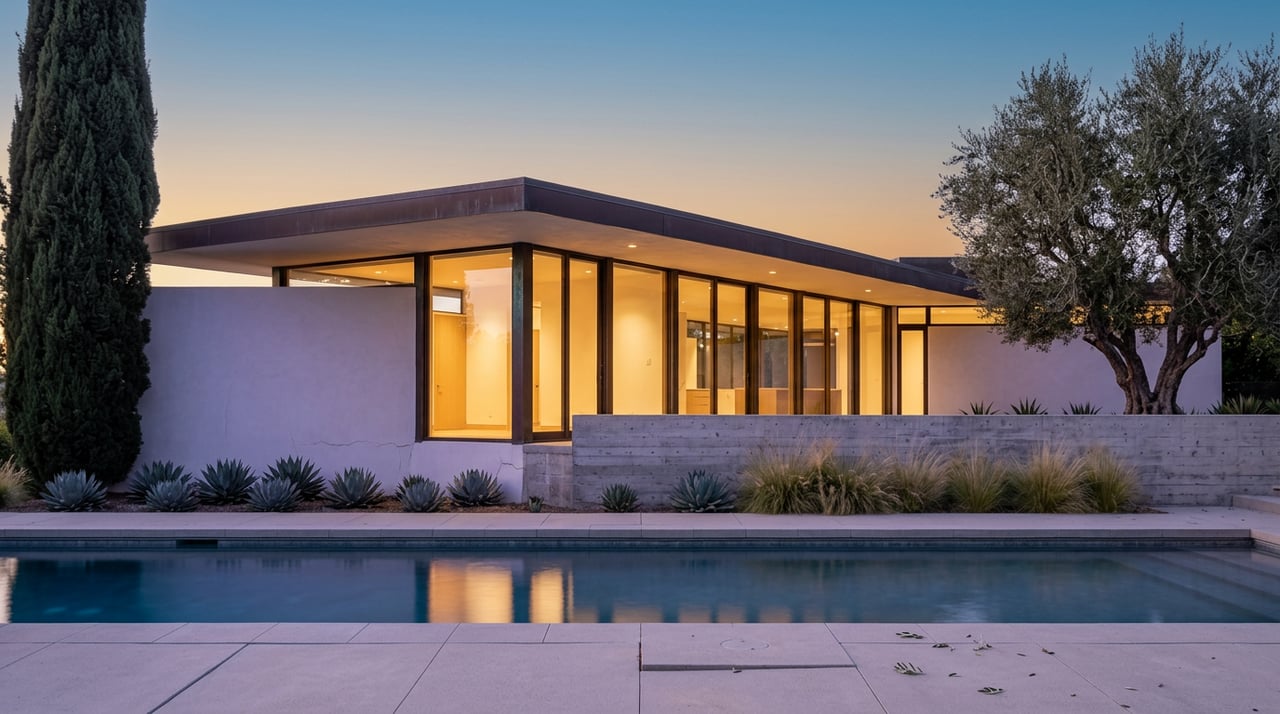
Marc Silver stood over one of the most unusual pieces of real estate in the Hollywood Hills last September and had to sell it twice at once. There was the house: a 1963 Lloyd Wright design on Senalda Road, pink-hued and cut into the hillside with the kind of glass and geometry that made Historic Places LA call it an excellent example of mid-century modern and organic residential architecture. And there was the story: David Lynch had lived and worked inside it for more than 35 years, expanding it parcel by parcel into a five-lot, seven-structure compound where he edited "Mulholland Drive," shot part of "Lost Highway," and ran his production company out of a building he called the Grey House.
The listing went out at $15 million. The compound closed roughly six months later for $13 million, a buyer whose name has not been made public. That $2 million gap, and the months it took to open, is the actual subject of this piece. Not because a discount is unusual in a slower market, but because of what kind of property took the discount.
What was actually for sale
Strip away the Lynch mythology for a moment and look at the real estate underneath it. The compound sits on 2.3 acres across five contiguous parcels just below Mulholland Drive, and it never functioned as a single home. It functioned as a small campus:
- 7017 Senalda Road, the Beverly Johnson House, Lloyd Wright's 1963 main residence, three bedrooms and three baths, the architectural anchor of the property
- 7029 Senalda, nicknamed the Grey House or Man Camp, headquarters for Lynch's production company, Asymmetrical Productions
- 7035 Senalda, known simply as the Studio, doubling as the Madison residence in "Lost Highway" and housing Lynch's private editing suite and screening room, the same rooms where "Mulholland Drive" was cut
- A pool and pool house designed in 1991 by Eric Lloyd Wright, Lloyd Wright's son and Frank Lloyd Wright's grandson, extending a rare three-generation architectural lineage on one property
- Additional structures known as the Crow's Nest and the Art Loft, plus a two-story guesthouse
Ten bedrooms, eleven bathrooms, 11,000 square feet spread across buildings that were never meant to share one buyer's daily life. A production office. An editing bay wired for sound and video. A screening room. These are function-built spaces, and function-built spaces come with a bill attached: whoever buys them either keeps paying to run a compound they don't need, or pays to convert rooms designed for film editing back into rooms designed for living.
The number underneath the number
Here is where the local tracking gets interesting. A neighborhood market recap covering that closing period put the Lynch sale at 125 days on market. National coverage of the same transaction described it as almost six months. Both can be true. They are likely counting from different start dates, one from a formal relisting event, one from the original September debut. The discrepancy itself is worth sitting with for a second, because it is a small reminder that "days on market" is not one clean number in this business. It depends on when the clock starts, and sellers of unusual properties should ask their agent exactly which clock they mean before they quote it to anyone.
What is not in dispute is the price. $15 million down to $13 million, a 13.3 percent cut. And the Lynch estate was not the only property moving through Outpost Estates that same window. A neighborhood recap of closings from the same reporting period showed two other sales worth putting next to it. A property known as Villa Dorado closed at $6.75 million after 149 days. Another home closed at $4.25 million after nearly a year of repositioning, down from an original ask of $4.895 million, a 13.2 percent cut, within a rounding error of the Lynch discount.
| Property | Original ask | Closed at | Discount | Time to close |
|---|---|---|---|---|
| Lynch compound, Senalda Road | $15,000,000 | $13,000,000 | 13.3% | ~4 to 6 months |
| Villa Dorado | not disclosed | $6,750,000 | — | 149 days |
| Single-family home, La Presa Drive | $4,895,000 | $4,250,000 | 13.2% | ~1 year |
Two homes, separated by nearly $9 million in price and by decades of cultural weight, landed within a single percentage point of each other on the size of their discount. One of them came with a working relationship to Frank Lloyd Wright's family lineage and a filmmaker's name attached. The other did not need either.
Provenance sells the showing, not the price
That is the finding worth remembering if you are pricing or shopping a story-driven property in this neighborhood right now. Architectural pedigree and celebrity history do real work here. They generate the press, the walk-throughs, the kind of attention that gets a compound onto Robb Report and Galerie before it ever reaches a buyer's desk. What they do not appear to do, at least based on this transaction, is override the same repricing math that governs every other piece of atypical inventory in Outpost Estates. A house that does not function as a straightforward single residence still has to find the specific buyer who wants what it actually is, and that buyer pool is narrower by definition than the pool for a move-in-ready home with a conventional floor plan.
Silver, who represented both sides of the deal, said in a statement quoted by Robb Report after the sale closed: "From the outset, it was important that the estate's architectural integrity and legacy be respected." The property's unusual features may have narrowed its potential buyer pool. Those same features can also make a sale take longer, even when the property is genuinely extraordinary.
Outpost Estates itself has room for this kind of ambiguity built into its architectural rules. The neighborhood's original 1920s deed restrictions, put in place by developer Charles E. Toberman, required homes to be built in Spanish, Mediterranean, or California modern style. That last category is why a Lloyd Wright mid-century compound was ever permitted to exist a few blocks from the neighborhood's signature red-tile roofs in the first place. The architectural range here is wider than the postcard image suggests, and that range is part of what makes provenance pricing so hard to standardize. A buyer paying for a Spanish Revival with a century of continuous ownership is pricing something different than a buyer paying for a modernist compound built for a working filmmaker.
What this means if you're pricing a story-driven property here
If you own or are considering an architecturally significant or provenance-heavy home in Outpost Estates, the practical takeaway is to separate the two numbers before you set an asking price. One number is what the story is worth to press coverage, to the pool of buyers who will tour a home because of who built it or who lived there. The other number is what an actual closing buyer will pay once they've priced in the cost of converting a production office back into a bedroom, or carrying five tax parcels instead of one. Pricing to the first number and expecting the second to follow is how a listing sits for months and closes at a discount that looks, in hindsight, entirely predictable.
The reverse is also true for buyers. A longer time on market in this neighborhood is not automatically a signal that something is wrong with the house. It can just as easily mean the seller priced for the story before the market had a chance to price for the function, and the eventual close reflects the gap between those two numbers finally narrowing.
Frequently asked questions
Does a celebrity former owner always raise a home's resale value in Outpost Estates? Not on its own. It raises visibility and can widen initial interest, but the closing price still depends on how usable the property is for an ordinary buyer. The Lynch compound's discount closely tracked a comparable discount on an unremarkable home sold the same period.
How should I price a multi-parcel or architect-designed property here? Get a clear picture of what it would cost a typical buyer to convert any non-residential space back to living space, and price with that cost already subtracted, rather than adding a premium for the story on top of a conventional comp.
What happens to spaces like a production office or editing suite when a compound like this sells? That depends entirely on the buyer. Some function-built rooms get converted to bedrooms or offices, others remain as workshop or studio space if the new owner has a similar use in mind. Either way, that flexibility is part of what a buyer is pricing when they make an offer on a non-conventional property.
If you're weighing what a provenance-rich home in Outpost Estates is really worth, or trying to price a multi-parcel property without overestimating what the story alone will carry, Neal Baddin has spent his career reading exactly this kind of nuance in the Hollywood Hills market. Request your instant home valuation and get a number grounded in what buyers here are actually paying, not just what a headline suggests they should.
This article is general information, not legal, tax or financial advice. Consult a qualified professional about your situation.